Subscribe to get access
Read more of this content when you subscribe today.
Missing this is part of the problem, the intent of the author matters. Many see the resulting gaps in focus as opening the need for other, non-adamic (non-people people literally) civilizations. The argument for a Pre-adamic race to explain Cain’s wife creates many problems of it’s own and I suspect is driven more from a…
There is a question, easily answered yet still oft repeated. I’m sure you’ve heard it as well. It’s the question “where did Cain get his wife?”
This video is an exposition of some common answers I hear from people who raise the question.
It may be fair as a question, but not if you’ve read the text. It also rarely stays that, and leads to weird places.
First, the question is already answered, both in Genesis before Cain even is born, and at other points in scripture.
20 The man called his wife’s name Eve, because she was the mother of all living
Genesis 3:20
That should be the end of it. But due to the incredible volume of people asking this question, and how much evidence there is against it, let’s continue.
3 When Adam had lived 130 years, he fathered a son in his own likeness, after his image, and named him Seth. 4 The days of Adam after he fathered Seth were 800 years; and he had other sons and daughters. 5 Thus all the days that Adam lived were 930 years, and he died.
Genesis 5:3-5
This caps off the life of Adam, and it contains an admission many children and their birthdates are not shared. Here the question can also be answered, Cain had many other siblings with unspecified ages who he could marry. So why only mention a few by name?
Remember what happens in Genesis 3? Like any account the author includes what he believes is relevant. He doesn’t care where Cain got his wife from, the issue from Genesis 3:15 on is where will the chosen seed who crushes the serpent appear.
I will put enmity between you and the woman,
and between your offspring and her offspring;
he shall bruise your head,
and you shall bruise his heel.”
Genesis 3:15
This is why only three women are named pre-flood, it isn’t the concern of the author. The author is concerned with which new Adam will succeed where Adam failed and crush the serpent’s head. How will God keep his messianic promise?
Missing this is part of the problem, the intent of the author matters. Many see the resulting gaps in focus as opening the need for other, non-adamic (non-people people literally) civilizations. The argument for a Pre-adamic race to explain Cain’s wife creates many problems of it’s own and I suspect is driven more from a fascination with hidden history and fantasy. Let us address a few of these arguments and their issues.
Genesis 1 and 2 in this view are said to be of the creation of different men and women. Both are one man and one woman, indicating they may be the same and both demonstrate dominion over the creatures, an oddity if they are not. God commissions the Man in Genesis 1 (1:26-31). No command is given for Adam in Genesis 2 beyond the command not to eat of the tree of good and evil (Genesis 2:9). In both cases however the man and woman are doing the same thing, dominion over the creatures and the world. Wouldn’t this be a conflict if they were two couples with overlapping dominion?
These are easily resolved by the traditional reading. Genesis 1 is the account of God’s act of creating the universe. So it is about God as creator. Genesis 2 is God’s special act of the creation of man. Humanity would naturally appear in both. Ignoring or missing this to create different humanities makes the whole fall apart.
Do we have two humanities with two different mandates, that overlap significantly? Why are there elements of the same covenant (a blessing for obedience, a curse for disobedience) in both? Where is the one humanity placed over the other? Could the one humanity eat from any tree but the other not? There’s more a gap here than “where did Cain get his wife.” Are there two humanities described in the same priestly language? The very word “man” is adam, the name Adam, which is where the entire species gets it’s name. We are all descendants of the same flesh, so we are Adamkind. This is why we have the same rights, and in Adam were all affected by the fall. We are his flesh and when he fell, we fell.
Now the author has answered where his wife comes from, because the author is very concerned with our common humanity, without which we do not have a common savior.
For as in Adam all die, so also in Christ shall all be made alive.
1 Corinthians 15:22
This is covenantal as well, but that only strengthens the point that it was made with Adam and all his posterity as the Westminster Standards teaches (WSC Q12). The fall is transmitted through the male line, which is why a virgin birth like that of Jesus is necessary to resolve the issue. That also makes male lines very interesting and important, right up to Jesus through the line of David whose house he is born into (Romans 1:3).
The implications of different lines of humanity doesn’t just ruin the name of Adam being the name for humanity. It doesn’t just make the name a weird misnomer for just one guy of many. It opens up the racist possibility of “how descended from Adam are you? Or are you one of those Genesis 1 or 2 humans?” It would be inordinately unfair for God to damn innocent humans for a federal head’s sin if they were not in Adam at the time. Common descent is central to our common salvation; the New Testament declares this.
And he made from one man every nation of mankind to live on all the face of the earth, having determined allotted periods and the boundaries of their dwelling place,
Acts 17:26
There is one savior because there is one nature, there is one nature because we are all descended from one man.
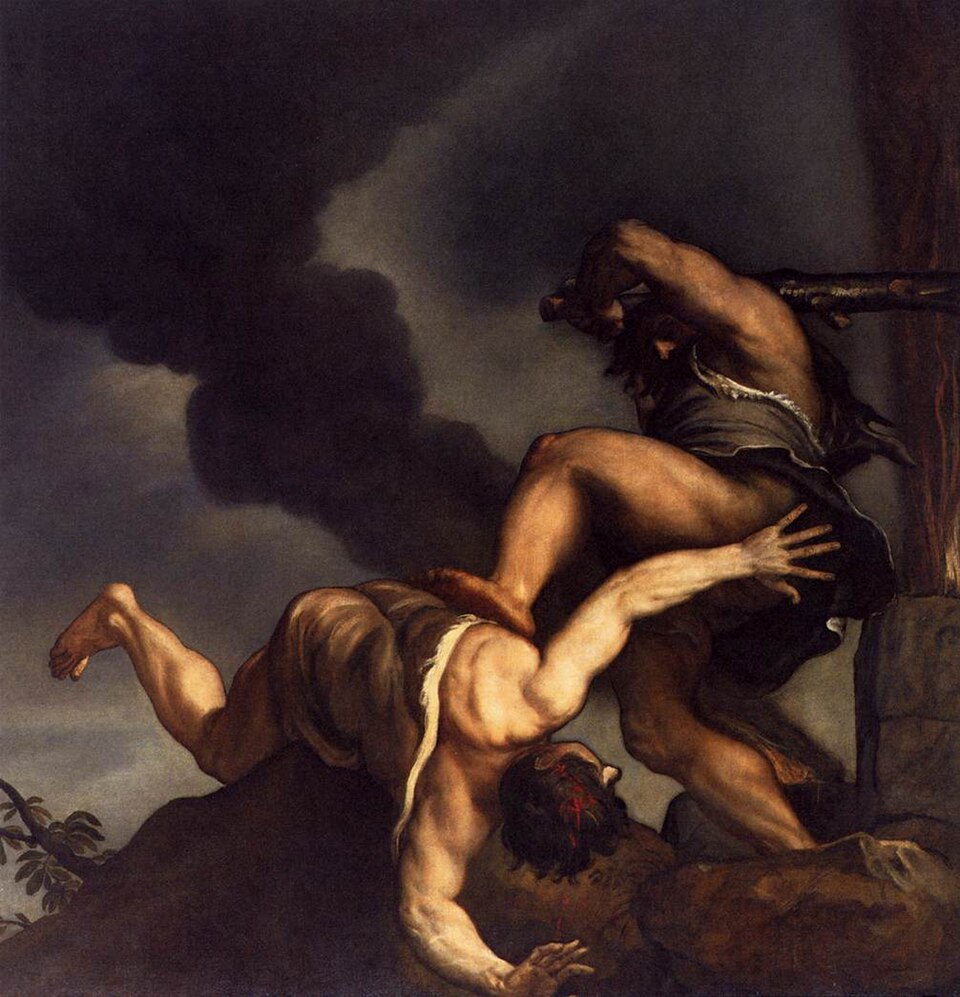
Now concerning Cain himself, his very name indicates the text like Eve, are both concerned with the chosen seed. His name literally means “gotcha,” a reference to Eve believing she had birthed her chosen savior. We know by his life however, that Cain was a seed of the serpent, killing his brother because God did not do things Cain’s way
2 And again, she bore his brother Abel. Now Abel was a keeper of sheep, and Cain a worker of the ground. 3 In the course of time Cain brought to the Lord an offering of the fruit of the ground, 4 and Abel also brought of the firstborn of his flock and of their fat portions. And the Lord had regard for Abel and his offering, 5 but for Cain and his offering he had no regard. So Cain was very angry, and his face fell. 6 The Lord said to Cain, “Why are you angry, and why has your face fallen? 7 If you do well, will you not be accepted?[b] And if you do not do well, sin is crouching at the door. Its desire is for[c] you, and you must rule over it.”
Genesis 3:2-7
Cain did not heed God’s warning. The incident following connects directly with the curse on Cain, because sin always has consequences.
8 Cain spoke to Abel his brother.[d] And when they were in the field, Cain rose up against his brother Abel and killed him. 9 Then the Lord said to Cain, “Where is Abel your brother?” He said, “I do not know; am I my brother’s keeper?” 10 And the Lord said, “What have you done? The voice of your brother’s blood is crying to me from the ground. 11 And now you are cursed from the ground, which has opened its mouth to receive your brother’s blood from your hand. 12 When you work the ground, it shall no longer yield to you its strength. You shall be a fugitive and a wanderer on the earth.” 13 Cain said to the Lord, “My punishment is greater than I can bear.[e] 14 Behold, you have driven me today away from the ground, and from your face I shall be hidden. I shall be a fugitive and a wanderer on the earth, and whoever finds me will kill me.” 15 Then the Lord said to him, “Not so! If anyone kills Cain, vengeance shall be taken on him sevenfold.” And the Lord put a mark on Cain, lest any who found him should attack him.
Genesis 4:8-16
Several things to note here. Cain murderers his brother out of some infantile jealousy. Cain is a small, egotistical man. Clearly the fall has been passed onto the next generation. God pronounces a curse that is far more gentle than Cain deserves, murder is a death penalty offence. He instead is spared and is given a a change in occupation and a wandering life. Cain’s concern is for himself, no remorse over killing his brother just his own discomfort. Still God does another thing, he protects Cain’s life by marking him off (possibly with a Paleo-Hebrew tav, which would be a cross). Cain however does this next.
16 Then Cain went away from the presence of the Lord and settled in the land of Nod,[f] east of Eden.
17 Cain knew his wife, and she conceived and bore Enoch. When he built a city, he called the name of the city after the name of his son, Enoch
Genesis 4:16-17
Remember the text is concerned with the seed line, not the women or their names. Is Abel the new Adam who will crush the serpent? Or is Cain? Oh look, Cain killed his brother. Guess it wasn’t either of them. We get the sad answer that it may be a long time, and a sad look at just how fallen the world was, and violent it would become.
But what may be missing is the vulgarity of which Cain lives his life. He goes East to a land that is called, Nod. Nod is probably a name the author of the section new it by, we can guess it was named by Cain because you know what it means? Wandering… He settles instead in a land he mockingly calls wandering.
When he does so he builds a city ( עִ֔יר v17), which Flavius Josephus1 says was a fortification. This is not demanded by the Hebrew, the word is generic for a settlement. Josephus also writes thousands of years later but let’s entertain the idea and you’ll see the focus is familiar themes from a man well-versed in his Old-Testament.
Some say this requires a lot of people to already be there. No, and Cain has many children who can fill the city over his long life, no doubt part of the point. Given Cain’s character, we should not be surprised he refuses to wander, instead he settles. If this is a fortified city, consider the mark God put on his head to protect him which we know is important to the text. What would Cain’s actions say about this? It’s a rejection, it would be saying I don’t need or trust it.
Cain also names the city after his son, because he is making a name for his own family line. This is all disturbingly similar to the tower of Babel. If this is a fortified city, it’s a rejection of both God’s curses and promise to protect Cain’s life making his own. It’s the first city regardless, and this sets the stage for later cities like Babel. It also isn’t said how long he built that city. For people living hundreds of years and having children most of that time, you could build a city yourself and have many children to fill it.
Regardless what Cain is doing is spitting in the face of God saying he doesn’t need God or his promises. Cain went from the presence of the Lord, away from Eden (the foot of which is where the sacrifices were made). Remember Eden is guarded by a retinue of Angels and is on a mountain, it is in essence a fortification. Cain may have built his own, rival fortification to defend himself, refusing to trust God and his promises. He has in any case built his own dwelling instead of turning to the dwelling of God.
I have largely argued concerning scripture but let us take a moment to discuss the objection concerning risk of inbreeding today. This risk is caused by too little genetic diversity, a problem for us now but consider a few things. We know Adam and Eve were living hundreds of years. They were genetically perfect meaning they carried no genetic corruption or load yet (aside from now carrying sin), so the accusation of inbreeding is anachronistic. What is often overlooked is how we need to be both genetically diverse and genetically similar to breed, in effect related but not too similar. For the first humans programmed by the hand of God, this is part of the design. After a genetic bottleneck like a flood however, we can see why inbreeding finally becomes forbidden in Leviticus 18:6-18, 20:17. At the time of Cain however, there was no lack of genetic potential in the original human family.
In short, the question “Where did Cain get his wife from” shows incredible ignorance as to what the text is actually asking. It’s a projection of a literalist Western approach (obsessed with data) onto a historical account (concerned with accuracy but not rote data) addressing the coming of the promised seed. The question is answered repeatedly, but not as the issue at hand.
Making this mistake of not seeing this leads to all sorts of bizarre contortions that compromise the message of scripture and works to the shame of those performing them. Damaging midrash throughout the church’s history have arisen from such bizarre and ignorant questions that see a problem where none exists. Not only is this assertion that there must have been other humans not found in the text, it is given as a response to a question where the answer is already in the text. It in short does what it accuses the other party of doing. The absurdity is incomparable.
You have to read the Bible not just in it’s genre’s, but it’s styles, themes, and as a comprehensive whole. The question I have found often arises from external pressures, and people forgetting the Bible (even the book of Genesis in itself) is a comprehensive whole.
Perhaps my irritation is showing, but this question exposes an incredible amount of literary ignorance, both in reading comprehension and cultural awareness. It’s time to put this silly question (and all the heresies created by believing it’s supposed solutions) to rest. And frankly for many, to repent for the violence they’ve done to the text, and to the church.


Leave a Reply