At risk is more than mere niceness, or family ties. What is in play is the elimination of all the distinctions God as created. Distinctions are the central act of creating, meaning the rejection of the family is outright rejection of God by denying his creative works.
There was (of course) a kerfuffle in Christian circles. This one got me thinking about what really lay underneath it. I will get to that, the incident is worth examinig first.
JD Vance mentioned the ordo amoris, the proper ordering of our loves and with them responsibilities. Owen Strachan chimed in calling your fellow Christians “your real family.” The argument, appealing to woke progressives today is that you should care more for the foreigner, and at the least less for your blood ties. Owen appears delighted to agree albeit in Christian phrasing.
This however is not something that scripture teaches, no matter how much praise Owen thinks it will get him.
8 But if anyone does not provide for his relatives, and especially for members of his household, he has denied the faith and is worse than an unbeliever.
1 Timothy 5:8
Your real family still remains your family, including the unbelievers among them. Otherwise, why pray for their salvation? Caring properly for them is a sign of a righteous individual. Your old responsibilities do not go away, regardless of new affinities.
Let’s look at a further test case
13 If any woman has a husband who is an unbeliever, and he consents to live with her, she should not divorce him. 14 For the unbelieving husband is made holy because of his wife, and the unbelieving wife is made holy because of her husband. Otherwise your children would be unclean, but as it is, they are holy. 15 But if the unbelieving partner separates, let it be so. In such cases the brother or sister is not enslaved. God has called you[a] to peace. 16 For how do you know, wife, whether you will save your husband? Or how do you know, husband, whether you will save your wife? -1 Corinthians 7:13-16
Your unbelieving family, here your spouse, still has real ties to the believer. You can only argue against this with passages taken out of context. Let us go to one.
48 But he replied to the man who told him, “Who is my mother, and who are my brothers?” 49 And stretching out his hand toward his disciples, he said, “Here are my mother and my brothers! 50 For whoever does the will of my Father in heaven is my brother and sister and mother.” Matthew 12:48-50
Notice though Jesus does still commission John to take care of his mother Mary.
25 but standing by the cross of Jesus were his mother and his mother’s sister, Mary the wife of Clopas, and Mary Magdalene. 26 When Jesus saw his mother and the disciple whom he loved standing nearby, he said to his mother, “Woman, behold, your son!” 27 Then he said to the disciple, “Behold, your mother!” And from that hour the disciple took her to his own home. 28 After this, Jesus, knowing that all was now finished, said (to fulfill the Scripture), “I thirst.” 29 A jar full of sour wine stood there, so they put a sponge full of the sour wine on a hyssop branch and held it to his mouth. John 19:25-28
Jesus is a good son, making sure his mother has the care her eldest son would give her. This sheds light on what he told the crowd, and Jesus serves as a good example of a loving son.
That said what is he talking about in Matthew 12? Jesus who spoke in parables and rhetorical hyperbole certainly wouldn’t use it here to correct a culture that worshipped its social structures would he?
Well, yes. Yes, he would. Neither does he eliminate the reality that they are his siblings. He does not deny that family connection. He points to a bond that is based on the first thing, obedience to God and the community he is creating. He does not eliminate the family; he uses it as an image to describe what else he has done.
26 “If anyone comes to me and does not hate his own father and mother and wife and children and brothers and sisters, yes, and even his own life, he cannot be my disciple. 27 Whoever does not bear his own cross and come after me cannot be my disciple. Luke 14:26-27
Looks like Jesus hates your family, until you see in this passage he is being rhetorical to undercut the idols of the culture. The imagery is intentionally shocking as a comparison, but it is a comparison to show you how much more dedication you are to have when you follow Christ. Your ties to your family are nothing compared to the claim Christ has on you. In a culture obsessed with family is everything attitude, that is a necessary rebuke. Jesus is saying you must love him immeasurably more than the people you love the most and be willing to lay down the one thing you think you have (your life) to follow him.
One also wonders what a Baptist does who can’t treat his children as Christians yet. But I digresss.
The disdain for those who remain your relatives portrays a very gnostic bent, one that denies the natural order that God has created. In a culture that doesn’t know it is a culture, doesn’t understand what a society is and has no clue how to handle its own relationships we really can’t be surprised this ugly discussion has happened. Even the Christians don’t know how God ordered the universe. And make no mistake, this is an attempt to disorder the universe by destroying the distinctions God has made.
But why the issues with family ties today? Why are people so eager to reject it, at times it seems especially in the church for a heavy-handed and sentimental idea contrary to nature?
At risk is more than mere niceness, or family ties. What is in play is the elimination of all the distinctions God as created. Distinctions are the central act of creating, meaning the rejection of the family is outright rejection of God by denying his creative works.
Take note.
1 In the beginning God created the heavens and the earth. 2 Now the earth was formless and empty, darkness was over the surface of the deep, and the Spirit of God was hovering over the waters.
3 And God said, “Let there be light,” and there was light.
Genesis 1:1-3
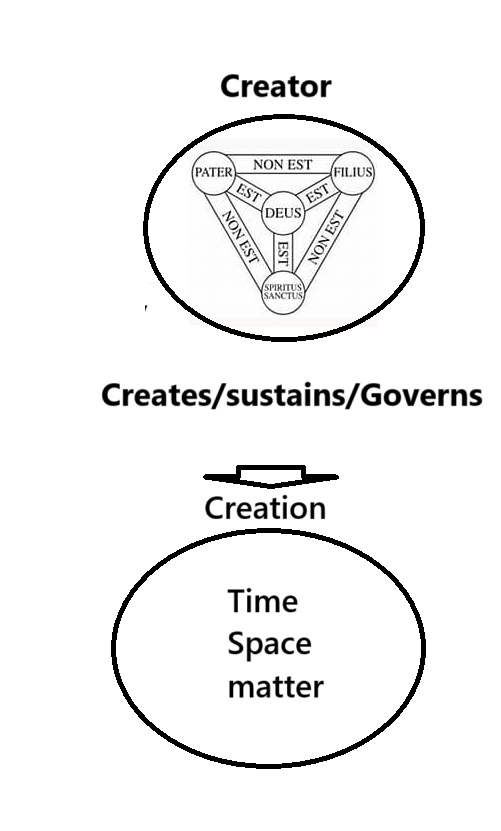
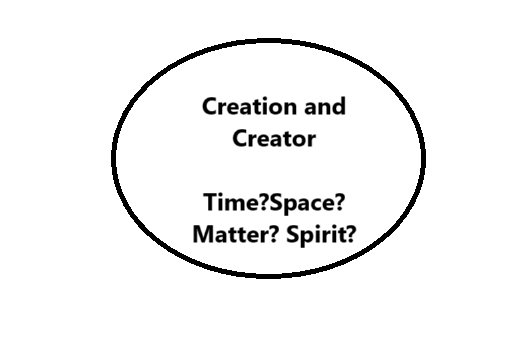
What do you see? We see what Peter Jones calls twoism. God already exists before the beginning, preceding time and the universe with it. No beginning is given him because he creates all things but has being in himself. So you see the Creator distinct from the Creation. In a nifty little image…
You will see it through the chapter, but it is a world formless and void, no real distinctions save the distinction of Creator and Creation. God then begins making the distinctions as he orders the natural world. Genesis 1, as the account focused on God as the creator, concludes with his specially distinct creature known as man.
25 God made the wild animals according to their kinds, the livestock according to their kinds, and all the creatures that move along the ground according to their kinds. And God saw that it was good.
26 Then God said, “Let us make mankind in our image, in our likeness, so that they may rule over the fish in the sea and the birds in the sky, over the livestock and all the wild animals,[a] and over all the creatures that move along the ground.”
27 So God created mankind in his own image, in the image of God he created them; male and female he created them.
28 God blessed them and said to them, “Be fruitful and increase in number; fill the earth and subdue it. Rule over the fish in the sea and the birds in the sky and over every living creature that moves on the ground.”
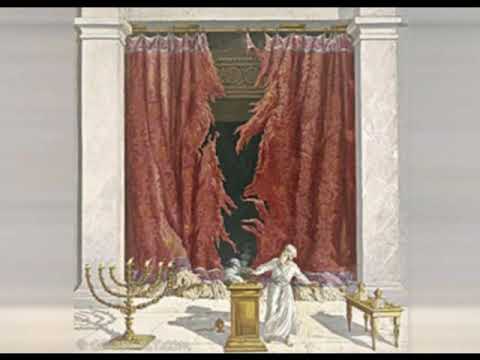
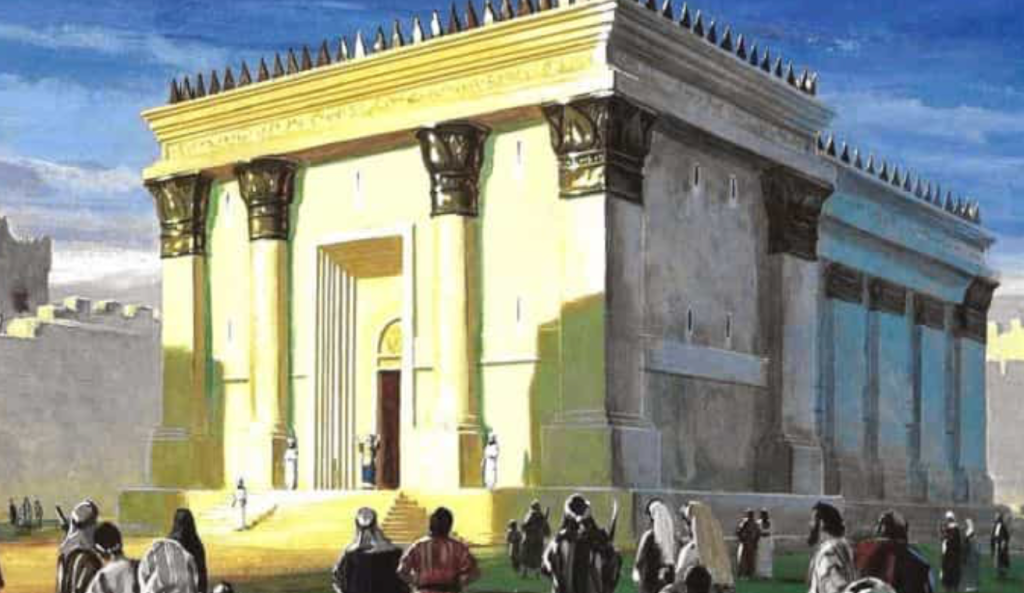
The temple follows the model of creation. Go back and read Genesis 1 with it in mind and you will see God is making a temple, and a special creature to guard the life in God’s house.
Denying the created order is ruining God’s house and poisoning the image bearers. Through Paul God tells us what this means in Romans 1
24 Therefore God gave them over in the sinful desires of their hearts to sexual impurity for the degrading of their bodies with one another. 25 They exchanged the truth about God for a lie, and worshiped and served created things rather than the Creator—who is forever praised. Amen.
Romans 1:24-25
Few things irritate as much as poor translations that destroy the point. The word for “created things” is one word, κτίσει. It is singular. Someone decided the passage was too general and it must mean created things. I trust Paul, but the point is not the things created but the creation as one thing. The world of nature becomes the creator, governor and sustainer in place of God. Divinity becomes an attribute of the creator. If divinity is in all things, making distinctions is heresy. Of course you would worship the animals, they are the divine. What you get is this…
Pantheism, or all being one
The point of denying your family connections is part of this, the attempt to collapse the opposites. There are no distinctions anymore. All is the same, all is equal. Any distinction (such as time, space, matter or spirit) is merely illusion, but then illusion is what? Not truth? You are still left with a binary. You can see how Paul then begins talking about sexual sin. If you deny the creator creature distinction all sex is the same. All of it….
And everyone is family, and families don’t exist. You are then commanded to simply love everything the same. For everything to be equal, so the absurdity goes, they must be identical. Of course, to have things to be equal implies two, and the differences with them. The whole endeavor is absurdity that cannot understand or affirm diversity. When you apply that to relationships, you get hatred for loving with any distinction.
Always look for the deeper issue at root. Don’t be Owen, who I can only assume is trying to appeal to people in their sin for the sake of attention. Affirm the goodness of the world God has made. Work within the boundaries he has set. They are a blessing and for your good.
That means loving your nearest neighbors, family, spouses, loved ones and neighbors with a special love.

 The Write Place
Leave a comment