Subscribe to get access
Read more of this content when you subscribe today.
Few things are as central to the message of structure as the image of the temple, and little is as important as what it means for us.
God, being the literary genius who authored history, leaves us many rich illustrations. They are not just in scripture, they are also the reality we live in and are to live by. Few things are as central to the message of structure as the image of the temple, and little is as important as what it means for us.
19 Jesus answered them, “Destroy this temple, and I will raise it again in three days.” 20 They replied, “It has taken forty-six years to build this temple, and you are going to raise it in three days?” 21 But the temple he had spoken of was his body. 22 After he was raised from the dead, his disciples recalled what he had said. Then they believed the scripture and the words that Jesus had spoken.
John 2:19-22
The Pharisees mocked because hearing they did not hear, and seeing they did not see. In fact, even the disciples were not sure of his meaning and only came to understand Jesus spoke of his body as the temple after his bodily resurrection. This imagery carries over to the Church itself.
6 Blessed and holy is the one who shares in the first resurrection! Over such the second death has no power, but they will be priests of God and of Christ, and they will reign with him for a thousand years.
Revelation 20:6
Our sharing in Christ’s resurrection by our union with him ties us to his description of what he has done with his body. One such use of the illustration teaches us about the nature of man as we are redeemed by Christ.
16 Don’t you know that you yourselves are God’s temple and that God’s Spirit dwells in your midst?
1 Corinthians 3:16
In the Old Testament we are shown God and man belong together. The task of God is to bring man back into his presence, to dwell with man. Humanity however is too sinful and cannot come into his presence until Christ atoned for sin. Until then God creates the tabernacle, then the temple. Much can be written about this, but notice the above passage. In the above Paul tells us that we are each a temple of God, and ought to live so. Remarkable as this is, he continues and applies it to the particulars in a Christians life.
Now let us go to the threefold use and threefold division of the law to instruct us on holiness.
The threefold use instructs us that the law serves to be a mirror, showing us what we are. Secondly, it restrains evil by giving us commandments. Third it reveals what is pleasing to God, showing us his character and his demands on us.
The threefold division consists of the Civil/Judicial, Ceremonial and Moral law. The Civil law passed with Israel but serves as general equity, giving principles for governance. The Ceremonial consists of the religious laws, also teaching us of the nature of sin and pointing to Christ’s atoning work. The Moral law is forever in its fullness, most typified in the 10 commandments, teaching us about God’s character and commands for conduct. Christ fulfills all of these, and in Christ Christians become more like Christ.
8 Instead, you yourselves cheat and do wrong, and you do this to your brothers and sisters. 9 Or do you not know that wrongdoers will not inherit the kingdom of God? Do not be deceived: Neither the sexually immoral nor idolaters nor adulterers nor men who have sex with men[a] 10 nor thieves nor the greedy nor drunkards nor slanderers nor swindlers will inherit the kingdom of God. 11 And that is what some of you were. But you were washed, you were sanctified, you were justified in the name of the Lord Jesus Christ and by the Spirit of our God.
1 Corinthians 6:8-11
Paul actually uses the law as I mentioned above. He references basic moral law, legal law in terms of conduct (cheating with lawfare), and the ceremonial law he uses to point back to what Christ has done by washing this holy possession of the Lord. Even the purity laws have some use today because they point to the completed work of Christ, and what he does in the believer. We may not have the sacrifices or the bloody covenant, but we have the one they point to.
I will digress for a moment to discuss the reference to male homosexuality. The translators lump two terms together. The terms are ἀρσενοκοῖται (men who lay with other men) and Μαλακοὶ (effeminate and transgendered). Both were used in pagan worship to symbolize the oneness of all things. Paul is creating a unique term with ἀρσενοκοῖται, taking the Greek Septuagint translation of Leviticus 20:13 and making what was two words one.
Paul using the terms here however does more than tell us these things are wrong. He tells us that among the redeemed are those who gave up their homosexuality and even stopped serving as transgendered priests. Keep going and see why these things are wrong, and what God has done for lost sinners. Paul goes from describing them as ones defined by actions, to some who were (ἦτε). Christians may flounder and fall, but they are no longer defined by the sins that consumed them. Even those whose lives were defined by pagan sexual practices are the temple.
16 Do you not know that he who unites himself with a prostitute is one with her in body? For it is said, “The two will become one flesh.”[a] 17 But whoever is united with the Lord is one with him in spirit.[b]
18 Flee from sexual immorality. All other sins a person commits are outside the body, but whoever sins sexually, sins against their own body. 19 Do you not know that your bodies are temples of the Holy Spirit, who is in you, whom you have received from God? You are not your own;
1 Corinthians 6:16-19
You can see how Paul uses both the three-fold use and divisions of the law as we continue. He refers back to it for personal conduct, legal conduct, and on a basic level the moral conduct that the Corinthians are falling so short on. The issue of sexual immorality in a new light when we consider human nature was intended to be the temple of God as it were. Christians are made the temple, here Paul notes this corporately.
Every Christian is a Holy place, and together are the same Holy place. So who you unite yourself to sexually or how you treat other members of the Holy place is incredibly important.
Chapter 6 begins by talking about the lawsuits and legal theft the church was engaging in. Roman law permitted, even expected the judge and jury in a civil case to be bribed. When you consider Christians were using this system to cheat each other you see Paul’s anger. When you consider how Christians are each a holy possession wherein God dwells, you can understand the sacrilege.
Sexual immorality was, and still is tied greatly to pagan ritual. Throughout scripture God’s people are called his bride. The sexual union we have in our bodies is a typological picture of God’s relationship to his people. If that is taken from it’s covenanted context of marriage (one man and woman), then it is bearing false witness and abusing what God has done. It is an experience for the whole of your nature, body and soul. This is known as the one flesh principle, referencing the creation itself.
Think of the absurdity of Christ engaging in sex with a prostitute and you see what Paul is getting at. Every Christian is individually a Holy place, together they are the holy place. Paul here says you (plural) are a temple (singular). What you do with your body affects the church as a whole because although every marriage is distinct, each is among the members of Jesus’ body. Every Christian is part of one temple.
Christians don’t care about sex because we are sticklers, or just because the culture in the West is obsessed about it. We care about you are sacred, and sex is sacred too.
Look at how this informs us about “race relations.’
19 Consequently, you are no longer foreigners and strangers, but fellow citizens with God’s people and also members of his household, 20 built on the foundation of the apostles and prophets, with Christ Jesus himself as the chief cornerstone. 21 In him the whole building is joined together and rises to become a holy temple in the Lord. 22 And in him you too are being built together to become a dwelling in which God lives by his Spirit.
Ephesians 2:19-22
The union we have with each other as Christians only exists by our union with Christ. Who Christ is then becomes of obvious significance.
Throughout we are not merely called a body, but a temple. But the word for temple is very specific (ναὸς). It is the word for the part of the temple where the God would dwell.

The temple of Venus at Rome
There’s an Old Testament parallel to this.
9 One of the seven angels who had the seven bowls full of the seven last plagues came and said to me, “Come, I will show you the bride, the wife of the Lamb.” 10 And he carried me away in the Spirit to a mountain great and high, and showed me the Holy City, Jerusalem, coming down out of heaven from God. 11
15 The angel who talked with me had a measuring rod of gold to measure the city, its gates and its walls. 16 The city was laid out like a square, as long as it was wide. He measured the city with the rod and found it to be 12,000 stadia[a] in length, and as wide and high as it is long.
Revelation 21:9-11, 15-16
The connection is clear here, the New Jerusalem is the bride of Christ. The New Jerusalem is a picture of the Church. The two are the same. John in shown a Spiritual reality of God’s people. What is lost on us who use the metric or imperial system is the significant of measurements. The Church is depicted as a cube. What is the significance of a cube? It’s the shape of the Holy of Holies.
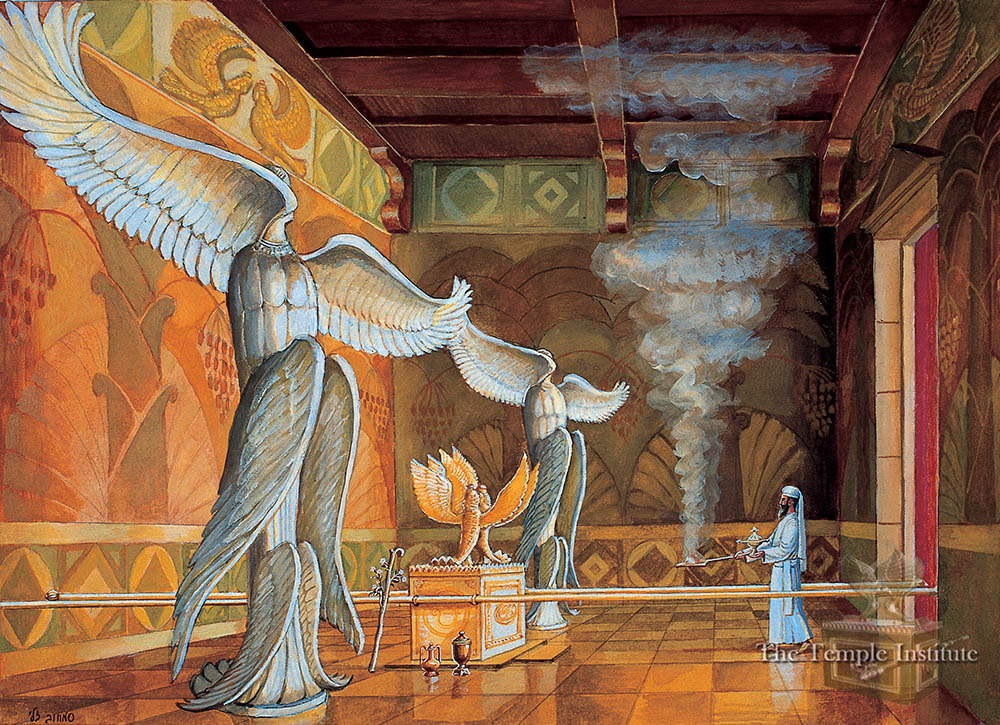
The Holy of Holies in Solomon’s Temple, via the Temple Institute
Tie all this together with Jesus words in John’s Gospel, and you will see we are his body and the new creation because we are united to the new creation, God made flesh who is the first fruits of the resurrection. We are called to live holy lives as new creatures because Christ has risen from the dead. Until he comes, we share in the first resurrection in its first fruits. Sharing in him, we have all things in Christ, we are called to live that way. God came and dwelt among us, now for Christians he dwells in us.

 The Write Place
Leave a comment