Subscribe to get access
Read more of this content when you subscribe today.
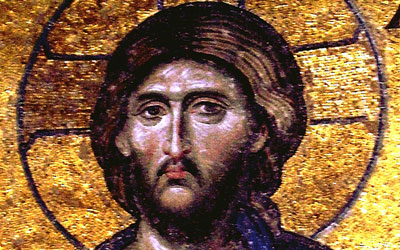
The character of Jesus is central to Christianity and claimed also by the Islamic religion. For Christians Jesus is the triune God incarnate, the coeternal logos. For Muslims he is a great prophet with the power of healing and resurrection of the dead[1]. Whatever the similarities Jesus appears fundamentally different between the two religions. Since…
The character of Jesus is central to Christianity and claimed also by the Islamic religion. For Christians Jesus is the triune God incarnate, the coeternal logos. For Muslims he is a great prophet with the power of healing and resurrection of the dead[1]. Whatever the similarities Jesus appears fundamentally different between the two religions. Since they disagree on the person of Jesus, the two religions in reality possess two different Jesus’. Suppose you and I had a mutual acquaintance, or I claimed as such. I start describing this person in a way that is different than the person you know, though I know a few stories about him. You would (logically) conclude I have heard of this person, but certainly that I did not know them. Such is the state of the Muslims with Jesus. The major difference between the two religions is deeply Christological. In Christianity Christ is central, Islam has no real Christology, for he is of little import being only another in a long line of prophets [2]. The point of departure between Christianity and Islam rests under the question of who Jesus is, starting with the nature of what Jesus is.
The virgin birth and Jesus’ divinity are intrinsically linked. The account of Jesus’ birth is one point of many similarities between Christianity and Islam, as well as many significant differences. Jesus was according to the Koran born virginally of his mother Mary. The Koran records the birth with an account similar to that found in Luke’s Gospel [3]. In the Muslim account the Angel Gabriel announces to Mary what Allah has done in her. Mary responds with the same questioning and acceptance as the Gospel account and Christ is announced as the Messiah (Surah an anbiyaa 21:91.)
Jesus’ Divinity and sonship are thoroughly denied in Islamic teachings. Muslims are exhorted that “God would never take to himself or beget for himself a son.” This also means Allah can never call a believer a son (compare to Ephesians 1:3-10), but more immediately denies any shared divinity or special relationship to Jesus. This strong denial of Christ’s divinity is at least in part because of the religious paganism of Mecca in Muhammad’s day. Like Israel and Judah under its wicked kings they worshiped a creator God with many other subordinated [4]. This is akin to a Christian sect worshiping angels or saints, a form of Henotheism. It could also (and no doubt is to some extent) be due to the creator(s) of Islam having exposure to Christianity largely through heretical sects such as the Ebionite, Eastern Monophysites, Nestorians and Docetists among other heretics. The author of the Quran seems to have a misunderstanding of the trinity claiming it to be God the father, Jesus the son and Mary the mother in Christian thought (Surah Al-Ma’idah 5:116-120) [5] largely due to his tremendous misunderstanding and exposure to these groups [6] and possibly the pre-existing Nabatean God Allah and the female God Al-lat.
Islam operates off of the thinking of the Pagan God’s and the image for the pagan God’s of Mecca possessing families and begetting carnally. What underlies his repulsion is the belief that God would have to have physical relations with Mary to beget a son, hence his hesitancy to even consider the term[7]. Christians too would shudder at the thought of our God acting in such a way. But the Christian trinity (Father, Son and Holy Spirit) is understood as eternal, spiritual begetting and procession. Christ never began to exist or became God, which is the logical conclusion for Muslims in this light. For Christians he is God and always has been though the Koran flatly denies such a claim [8]. Worship of Mary however may also be the source of Islam’s ultimate complaint as it had gone from veneration to worship in the sects he contacted.
This lack of an incarnation ties very strongly to the attributes of the God of Islam[9]. The Islamic God is almost entirely transcendent. What is important in Islam is God’s will not atonement. Islam does speak at length of sin and mercy but not guilt and love[10]. Mercy is earned, guilt would imply a state of being whereas sin is capable of being limited to an act or account. This has led to Islam being accused of being essentially deistic [11]. Mercy is seen as an essential of the God of Islam, but this God lacks the grace of the Christian God and any mention of grace at all. Mercy can be earned; grace is freely given underpinning the difference that Islam is a religion of works whereas Christianity is a religion of grace where God makes man righteous. The Islamic relationship is man seeking God, the Christian relationship shown in incarnation and salvation by grace, centers on God seeking man.
Islam reduces Christ to a slave and a servant of God which reflects in the relationship a Muslim likewise has with God. A God who would never come down to man is likewise a God whose favor must be earned. He is not the loving God of Christians in the person of Jesus who came down in the flesh. Christ taught God as a loving father, very different from the radical monad that is the Muslim God [12]. Many Muslims are thus attracted to Jesus and the loving God he taught [13] before they are ever attracted to Christianity. This raises the question however, as to why the virgin birth exists in Islam if it is of no significance. Yet the birth of Jesus is also shown to be of tremendous consequence in Islam. Muslim’s do speak of great upheaval spiritually and of demons shaking in terror [14] at his birth. The devil himself who had been able to travel all seven layers of the heavens was afterwards confined to three [15]. Though the Koran records that his coming was so great that every idol the world fell over on its face,[16] the birth is robbed of its Christian significance. By Shiite tradition (hadith) Muhammad upon entering Mecca in 630 AD when cleansing the icons and idols from the Kaaba left those of the Virgin Mary and Jesus [17]. They are both held in high esteem, and one tradition holds that Mary and Jesus are the only people never to be touched by Satan upon his birth [18]. For Christians the virgin birth is essential and sensibly significant. It is God himself coming in the flesh to save his people from sin and death in the incarnation.
For the Muslims however Jesus is another prophet with a unique birth, nothing more. Adam’s creation is considered greater as he was life from non-life and there is no divinity in Jesus[19]. Jesus is called the son of Mary as opposed to being addressed as the son of God in the Koran, a strong denial of divinity [20]. The Muslim God would never “get his hands dirty” [21] with an incarnation, his transcendent station denies this. But since in Islam there is no original sin, the need for a virgin birth is also negated.

Jesus in Byzantine art, one half of his face depicting his human nature, the second distorted to show his present divine nature.
Curiously, Jesus further acts as a sort of wunderkind in Islamic theology from childbirth. Jesus acts as a prophet from birth [22] and in the Shiite Hadith from the age of two on [23]. From the cradle Jesus could speak and fulfilled prophetic duties in this way. Surah 19 reports that after his birth and upon returning home, his mother Mary was accused of immorality [24]. Jesus spoke up in her defense and asserted his station as prophet. This contrasts with the Christian account when the child “grew in knowledge” as recorded in Luke 2:52. Here we see Jesus in Islam in some ways lacks his humanity as well as his divinity. He is superpowered but does not go through what we can consider a human experience.
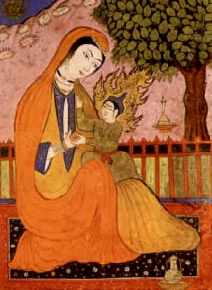
A depiction (forbidden at that) of Mary and Jesus in Islamic lore.
Naturally from these different understandings of what Jesus is between Christianity and Islam, he differs also in how they understand his calling. Jesus in his prophetic role in Islam came to enact another dispensation in God’s revelation [25]. This was to be shown in the Injil (the Christian Gospels) before they were supposedly corrupted by Jesus’ followers. Paul the Apostle often bears the brunt of this criticism. Paul’s initial reception by the Apostles is oft cited [26]. Critics often claim that the adoptionists and subordinations may have been the more accurate Christians before Paul’s “corruption” [27]. However, this overlooks Paul’s lack of reason to suddenly convert to a faith he persecuted so harshly. Paul’s later kind words and the overall acceptance of Paul by those who knew Christ further validates him (2 Peter 3:15). The objection that this was a later Pauline edit is ahistorical and fictitious, founded on an assumption that such must be the case as theology develops along Hegelian lines (thesis meets antithesis, producing a syncretism, as there is no God who comes into nature).
Contrary to Christian doctrine, Jesus’ mission in Islam was limited only to the Jewish nation. He is even called the Messiah in Arabic, and this was his role [28] but it differs greatly from that as the Christian Christ. While a messenger he had no apparent purpose outside of his prophetic role of turning back literal ethnic Israel (God’s will again in focus). The term has no real deeper meaning in Islam whereas Christ’s role as the anointed is thoroughly developed in Christian circles [29]. This provides a strong opportunity to point Muslims to the biblical definition and development of this.
Jesus is set apart from other prophets of Allah in that he never sinned [30]. While it is claimed men like Moses, Abraham and Muhammad never sinned there are recorded instances of them committing sins in the Koran. In spite of this Orthodox (Sunni) Islam teaches that they somehow never sinned, Jesus stands as the only one who was truly sinless [31]. For the Christian this poses no contradiction or problem. He came in Christian Christology as God and remained sinless to be the perfect and pure atonement. Islam contains the vestiges of his divinity in his sinlessness without understanding the core of his character in this way.
Interestingly Jesus is credited with performing many miracles including healing and resurrection in Islam. Muhammad is credited with the miracle of receiving the Koran but no such miracles. This facet of his character draws many Muslims to Christ often before they come to Christianity [32]. Jesus claims to forgive sins in the Gospel (Matthew 9:6; Mark 2:9-11). For the Christian this makes perfect sense, as God he can forgive sins, and so understood the Pharisees who hated him for this. In Islam this story has no explanation, and no reason for a prophet to have this power is given. Terms word and spirit are also credited to him, but without divinity, him being created by divine fiat in the virgin birth [33].
The Muslim God is much like Arius’ God, singular in person, unable to share in substance and totally unique and so is excluding of Jesus’ divinity [34]. Jesus is still called the word of God in that he preaches, and the spirit of God in that he is sent from God [35]. Christianity in contrast proclaims him the word, the logos. In the beginning the word was with and was God, acting as the agent of creating. We see in Islam echoes of the Trinitarian formula, filtered almost certainly through secondary sources in these titles of Word and Spirit of God.
Jesus’ crucifixion is not just robbed of importance, but even denied. There are several prevailing theories about how it did not happen. The theory that Jesus passed out appearing dead (swoon theory) is the second most popular. Some say it was Peter, Judas or Simon of Cyrene (the most common) made to appear as him and crucified in his place and he was taken up in this so-called substitution theory[36]. This of course demands that everyone including his mother failed to recognize it was not him on the cross.[37] Often cited is the Gospel of Barnabas which proclaims Judas was crucified in his place [38]. This is an odd argument to make, considering these were written not in the 1st century by his associates, and also were excluded from the canon because they weren’t orthodox and imitate heavily the heresy of Docetism (which possesses significant issues from an Islamic standpoint). Some Muslims even claim the Docetists as the original account. Of course, this whole scenario of fooling people, means Allah also unintentionally started Christianity.
The Koran does not appear to deny his crucifixion, merely that the Jews performed it (Surah An-Nisa – 157 ). Some Muslims theologians posit that Allah himself may have taken his servant back like Moses (4:157) avoiding the shame of having a prophet murdered [40]. Often Apocryphal writings are used to combat Christian doctrine, claimed to be early church theology before it was corrupted. Without the death and resurrection that accomplished there is no atonement or redemption in Islam [41]. Allah simply abrogates his law and has no satisfaction to his justice. Without the cross theology falls apart.
Notable Islamic scholars have struggled with the crucifixion as well allowing for the very real possibility that, Jesus was in fact crucified and died. In spite of all this doubt, it has remained orthodox to deny his crucifixion. This largely stems from the perceived insult to Allah that his prophet should die and, in a way, so public and humiliating. Christians are guilty of falling into a cross heavy theology, missing or neglecting the victory in the resurrection. Islam gets caught on this much the same way seeing only the shame of the cross they miss the Christian demonstration of God’s victory and power that is found in the resurrection [42].
Christ still in Islam, as he does in Christianity plays a very vital role in eschatology, albeit it not at the center in Islam. Jesus is expected in Islamic Shiite eschatology to return before the 12th Imam (the Mahdi) and descend on Damascus, not Mount Olivet in Jerusalem as in Christianity. All Muslims expect Christ to return and burn all the churches, break the cross [43], kill the pig, end the Jizya (tax on non-Muslims) and force all of the world (namely Christians) to turn to worshiping Allah. He will show them of their offence and how he is not God but a prophet. Jesus is expected to be asked to lead prayer after vanquishing Islam’s enemies and show humility by letting the 12th Imam lead prayers instead [44]. Jesus’ coming ironically is eagerly awaited and expected by Muslims the world over.
There is as has been noted, a tremendous difficulty reconciling his return with the stated belief that he never died. There is no explanation for the resurrection, Christ’s appearances or his ascension without Christian understanding [45]. There is no explanation as to why he would be immortal or be the agent of judgment other than to witness against the Christians (a task which Muhammad has already performed). This also leaves the question of with Jesus alive and a prophet, what reason there is for Muhammad as prophet since in Islam there can only be one at a time. The bible is quite clear; Christ died for our transgressions, was buried and raised on the third day. Islam borrows from the Christian eschatology that Jesus will return to judge the earth and his kingdom will be realized on earth in it’s fullness.
The Muslim Jesus bears many similarities, no doubt borrowed from Christian, albeit heretical scripture and tradition. They lack a proper Christology, but remarkably in their tradition and scriptures retain much of Jesus’ history. In spite of this they lack knowledge of who he is, only knowing some of what he’s done. These point to his divinity and a Christian Christology which is overlooked and even denied, but that is latent. Only with a Christian theology is there a loving and immanent God, the cross being rightly called the missing link in Muslim creed. Without a triune God, God cannot relate or love [46]. The Christ’s of Islam and Christianity are indeed two fundamentally different beings. Robbed of the incarnation, Islam is about man seeking after God. Christianity has the greater and only hope in Jesus, God seeking (and finding) man.
Bibliography
The results of a recent survey of converts from Islam. Christianity today, October 24, 2007, Warren Larson, Jesus in Islam and Christianity, Missiology: An International Review, Vol. XXXVI, no. 3,(July 2008)Anthony McRoy, The Christ of Shia Islam, Evangelical Review of Theology, (2006) 30:4, 340
Dirks, Jerald F. “The Abrahamic faiths: Judaism, Christianity and Islam, similarities and contrasts. Beltsville Maryland. Amana publication, (2004)
The results of a recent survey of converts from Islam. Christianity today, October 24, 2007, 8
[2] Warren Larson, Jesus in Islam and Christianity, Missiology: An International Review, Vol. XXXVI, no. 3, July 2008, 328
[3] Anthony McRoy, The Christ of Shia Islam, Evangelical Review of Theology 2006, 30:4, 340
[4] Zwemer 69
[5] Ibid. 69
[6] Ibid. 70
[7] Larson 332
[8] Ibid. 331
[10] Zwemer 66
[11] Ibid. 66
[12] Ibid. 66
[13] CT 81
[14] McRoy 345
[15] Ibid. 345
[16] Larson 327
[17] Ibid.327
[18] Ibid. 327
[19] McRoy 341
[20] Larson 329
[21] McRoy 341
[22] Larson 329
[23] McRoy345
[24] Larson 328
[25] McRoy 341
[26] Dirks, Jerald F. “The Abrahamic faiths: Judaism, Christianity and Islam, similarities and contrasts. Beltsville Maryland. Amana publication, 2004, pg95
[27] Abe 112
[28] Larson 330
[29] Larson 330
[30] Larson
[31] Larson 332
[32] CT 83
[33] McRoy 341
[34] Dirks 114
[35] Larson 331
[36] Larson 333
[37] Larson 335
[38] Dirks 98
[39] McRoy 341
[40] McRoy 341
[41] Zwemer 75
[42] Larson 333
[43] Larson 335
[44]McRoy 350
[45] Larson 336
[46] Zwemer 75

 The Write Place
Leave a comment